Total Recyclables Collected: 362,459 kilos
Philippines Commits to 93% Plastic Pollution Reduction by 2040
The National Plastic Action Partnership (NPAP), in collaboration with the Department of Environment and Natural Resources (DENR), led a national public consultation to validate the draft National Plastic Action Roadmap. The event finalized a framework designed to address the Philippines' escalating plastic pollution crisis.
by Mitchell Gimena
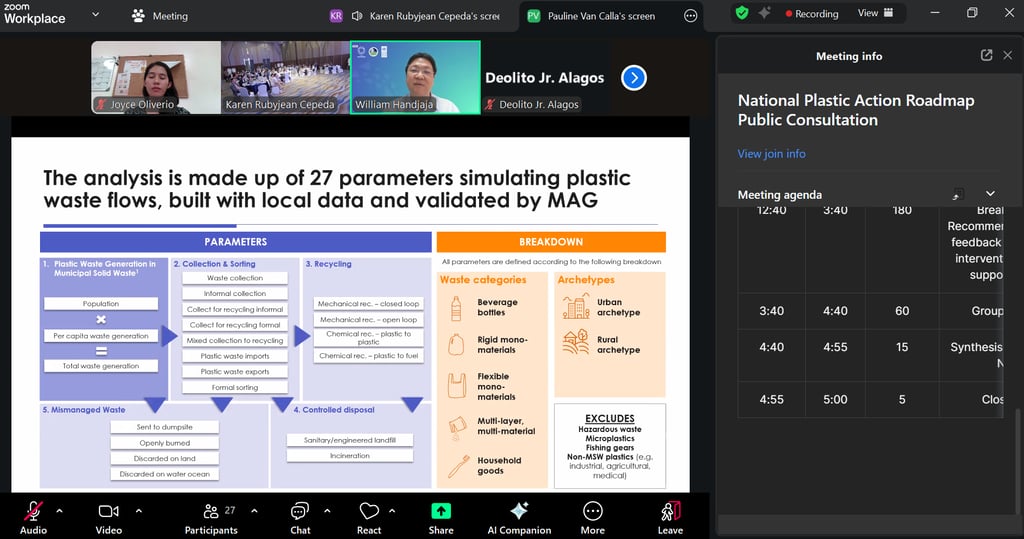
MANILA — The National Plastic Action Partnership (NPAP), in collaboration with the Department of Environment and Natural Resources (DENR), led a national public consultation to validate the draft National Plastic Action Roadmap. The event finalized a framework designed to address the Philippines' escalating plastic pollution crisis.
The proposed roadmap outlines a System Change Scenario (SCS), which projects a reduction in plastic pollution by 93% by 2040. Currently, the Philippines generates approximately 1.8 million tonnes of plastic waste annually, with nearly three-quarters being mismanaged. According to presenters, pollution levels could nearly double by 2040 without the comprehensive intervention detailed in the plan.
The SCS is projected to significantly increase the national recycling rate to 37%, cut government operational costs, and create a substantial number of green jobs.
Key Action Points and Challenges
The strategy is built on an 8-Point Action Plan focusing on policy reform, financing mechanisms, governance improvement, and the enhancement of reuse and recycling systems.
Dialogue among stakeholders—including representatives from the DENR, DILG, NEDA, LGUs, the private sector, and civil society—underscored critical challenges to implementation:
Enforcement Gaps: Weak policy implementation and inconsistent legal interpretation across local government units (LGUs).
Resource Constraints: Lack of adequate manpower and financial resources at the local level.
Infrastructure: Limited available space for establishing necessary Material Recovery Facilities (MRFs).
Waste Worker Welfare: A recurring need to formalize and protect informal waste workers, necessitating legal support such as the proposed Magna Carta for Waste Workers, to ensure fair treatment and inclusion in formal systems.
The consultation concluded with a consensus to integrate these insights into the final version of the roadmap. NPAP and DENR committed to establishing technical working groups to guide the strategy's national and local execution, reinforcing the goal of achieving a sustainable, low-plastic circular economy by 2040.